Industrial Glove Thickness MIL Guide: Engineering Standards and B2B Sourcing
In industrial safety procurement, protective handwear thickness is a fundamental technical metric determining tactile sensitivity, mechanical durability, and chemical permeation resistance. However, terminology like “mil,” “gauge,” and “microns” frequently causes confusion among procurement managers and PPE distributors. Selecting the appropriate glove thickness requires evaluating the specific workplace hazard—whether fine electronic assembly, heavy equipment maintenance, or aggressive solvent handling. This technical guide outlines how mil thickness is measured, converted, and applied across industrial manufacturing operations.
What Does “MIL” Mean in Glove Manufacturing?
A “mil” is an imperial unit of linear measurement equal to one-thousandth of an inch ($0.001text{ inch}$). It is not shorthand for millimeter. One mil equals approximately $0.0254text{ millimeters}$ or $25.4text{ micrometers (microns)}$. In glove manufacturing, mil ratings specify the thickness of the protective film or barrier coating across critical contact zones, most notably the palm, fingertips, and cuff.

Industrial Glove Thickness Conversion Reference Table
Converting between mils, millimeters, and microns simplifies cross-referencing technical spec sheets between North American and European suppliers:
| Mil Rating (mil) | Inches (in) | Millimeters (mm) | Microns ($mutext{m}$) | Typical Industrial Application |
|---|---|---|---|---|
| 3.0 mil | 0.0030 in | 0.076 mm | 76 $mutext{m}$ | Precision electronics, food service, lab inspection |
| 4.0 – 5.0 mil | 0.0040 – 0.0050 in | 0.102 – 0.127 mm | 102 – 127 $mutext{m}$ | Standard automotive assembly, light manufacturing, janitorial |
| 6.0 – 8.0 mil | 0.0060 – 0.0080 in | 0.152 – 0.203 mm | 152 – 203 $mutext{m}$ | Heavy mechanical maintenance, aerospace, paint prep |
| 10.0 – 12.0 mil | 0.0100 – 0.0120 in | 0.254 – 0.305 mm | 254 – 305 $mutext{m}$ | Chemical processing, parts washing, extended duty cycles |
| 15.0 – 20.0 mil | 0.0150 – 0.0200 in | 0.381 – 0.508 mm | 381 – 508 $mutext{m}$ | Heavy immersion, hazardous acid handling, abrasive blasting |
How Glove Thickness Is Scientifically Measured
Accurate thickness testing adheres to international quality standards such as ASTM D3767 or EN 420 / ISO 21420. Measurements are recorded using a calibrated dead-weight dial micrometer applying a standardized foot pressure across three designated anatomical zones:
- Fingertip: Measured approximately 13 mm from the tip of the middle finger. Fingertip thickness is typically higher to resist puncture from tools and sharp components.
- Palm: Measured at the geometric center of the palm surface. This zone provides primary abrasion and chemical permeation resistance.
- Cuff: Measured approximately 25 mm from the cuff edge. Cuffs are frequently engineered slightly thinner to ensure flexible donning without tearing.

Thickness vs. Protection: The Engineering Trade-Off
A common misconception in PPE sourcing is that a thicker glove inherently provides superior overall safety. In reality, protection depends heavily on polymer formulation, crosslink density, and mechanical construction:
- Tactile Sensitivity and Dexterity: Thicker gloves increase finger resistance, resulting in hand fatigue during repetitive manipulation of small fasteners. Thinner barriers optimize sensory feedback and fine motor control.
- Chemical Permeation Breakthrough Time: For hazardous solvent and chemical handling, thickness directly correlates with longer breakthrough times according to ASTM F739 standards. However, polymer compatibility remains paramount; a 15-mil nitrile glove may fail rapidly against ketones where a specialized butyl formulation excels.
- Mechanical Cut and Tear Resistance: In cut-and-sewn industrial handwear, mechanical protection is driven by high-performance yarns (such as HPPE, aramid, or steel core) and polyurethane or nitrile palm dips rather than raw film thickness alone.
OEM Industrial Handwear Sourcing from Mi-Gloves
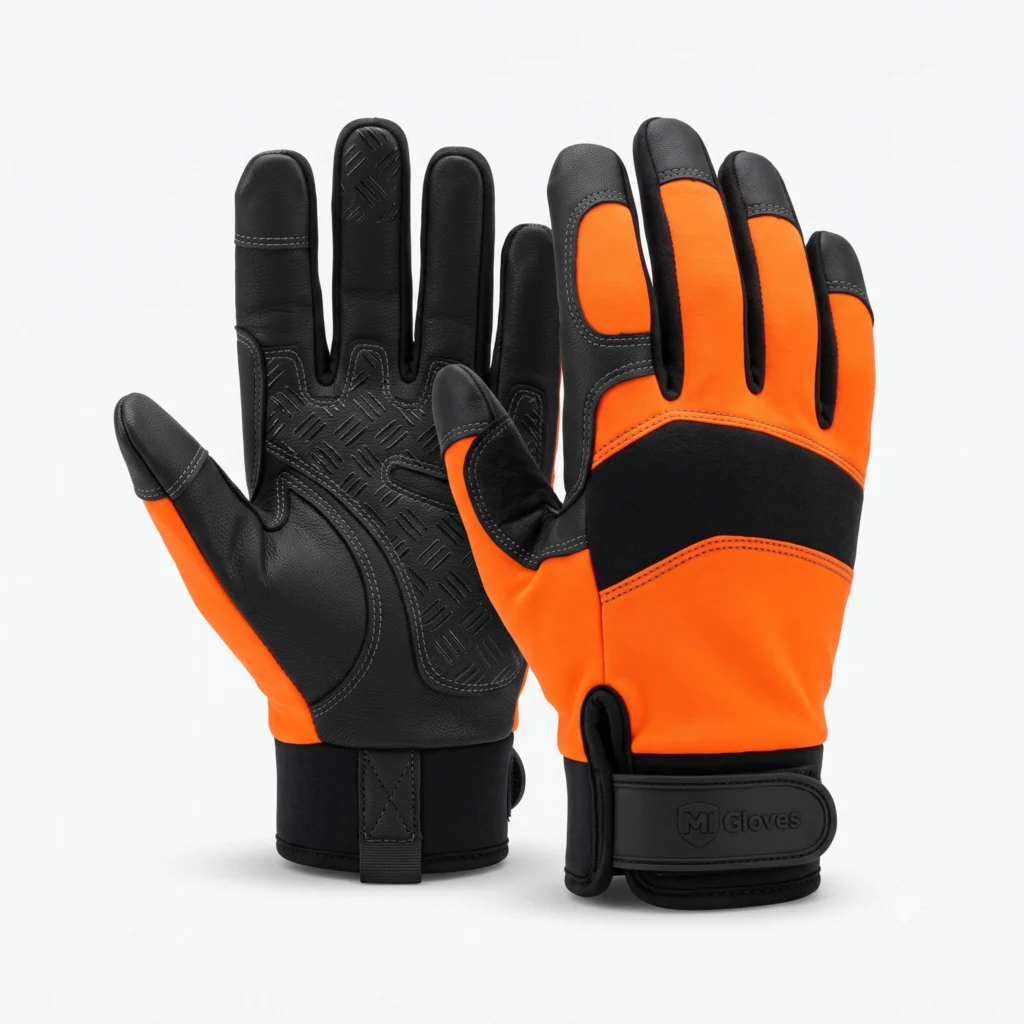
Mi-Gloves specializes in engineering cut-and-sewn protective gloves, high-dexterity mechanics handwear, and specialized thermal industrial barriers. While commercial commodity disposable nitrile gloves dominate standard retail channels, our manufacturing facility focuses on high-value, engineered protective equipment built to customer technical specifications.
Consult with our product development specialists for custom industrial gloves, learn more about our facility as a certified B2B glove manufacturer, or explore our engineered extreme cold thermal gloves for industrial cold-storage operations.
Frequently Asked Questions (FAQs)
Is a higher mil rating always better for industrial safety?
No. While higher mil ratings provide greater chemical permeation resistance and puncture durability, they significantly reduce tactile sensitivity and increase hand fatigue during intricate tasks. Sourcing managers should select the thinnest glove that meets the certified safety threshold.
What is the difference between glove mil and fabric gauge?
Mil measures physical barrier thickness ($0.001text{ inch}$), whereas gauge measures the number of knitting stitches per inch in seamless knitted glove liners (e.g., 13-gauge, 15-gauge, or 18-gauge). Higher gauge numbers indicate a thinner, more flexible knitted liner.
Why do palm, fingertip, and cuff thicknesses vary on the same glove?
During the dipping and forming manufacturing process, liquid polymers naturally flow and accumulate differently over anatomical hand formers. Manufacturers calibrate mold orientation to concentrate thickness at high-wear finger zones while keeping cuffs flexible.
How does mil thickness affect electrical safety gloves?
In dielectric insulating handwear, rubber thickness directly determines certified voltage resistance classes (such as Class 00 through Class 4). Thicker dielectric rubber barriers prevent electrical breakdown under thousands of proof-test volts.
Can mil thickness be verified by weight?
Glove weight (grams per piece) provides a secondary quality benchmark, but it cannot replace micrometer thickness testing. Variations in polymer density, compounding fillers, and length can alter weight without reflecting true barrier thickness.
What documentation should B2B buyers request to verify glove thickness?
Buyers should request Certificate of Analysis (COA) documents, ASTM D3767 dimensional inspection sheets, and standardized batch quality control reports from the manufacturer.