Sublimation Printing on 65% Polyester Blends: Textile Sourcing and OEM Guide
In sportswear manufacturing, performance glove production, and corporate workwear, product designers frequently seek the ideal balance between the vivid, permanent graphic capabilities of dye-sublimation and the natural, soft breathability of combed cotton. This search frequently leads to 65% polyester / 35% cotton blended textiles (commonly known as 65/35 poly-cotton). However, commercial buyers must navigate critical technical trade-offs before approving 65/35 blends for mass sublimation printing. Can you sublimate on 65% polyester? What does the final print look like after commercial laundering? How does blend variance impact production consistency and brand perception? This B2B guide provides an empirical analysis of dye-sublimation on blended fabrics, technical press parameters, and private-label contract manufacturing capabilities at Mi-Gloves in Sialkot, Pakistan.
The Science of Sublimation on 65/35 Blended Yarns
To understand the aesthetic and technical outcome of sublimating on a 65% polyester / 35% cotton blend, one must examine yarn-level dye absorption. During industrial heat press cycles (190°C–205°C), gaseous disperse dye molecules react exclusively with the 65% synthetic polyester filaments. The remaining 35% cotton fibers lack chemical receptivity to disperse dyes and repel the gaseous ink:
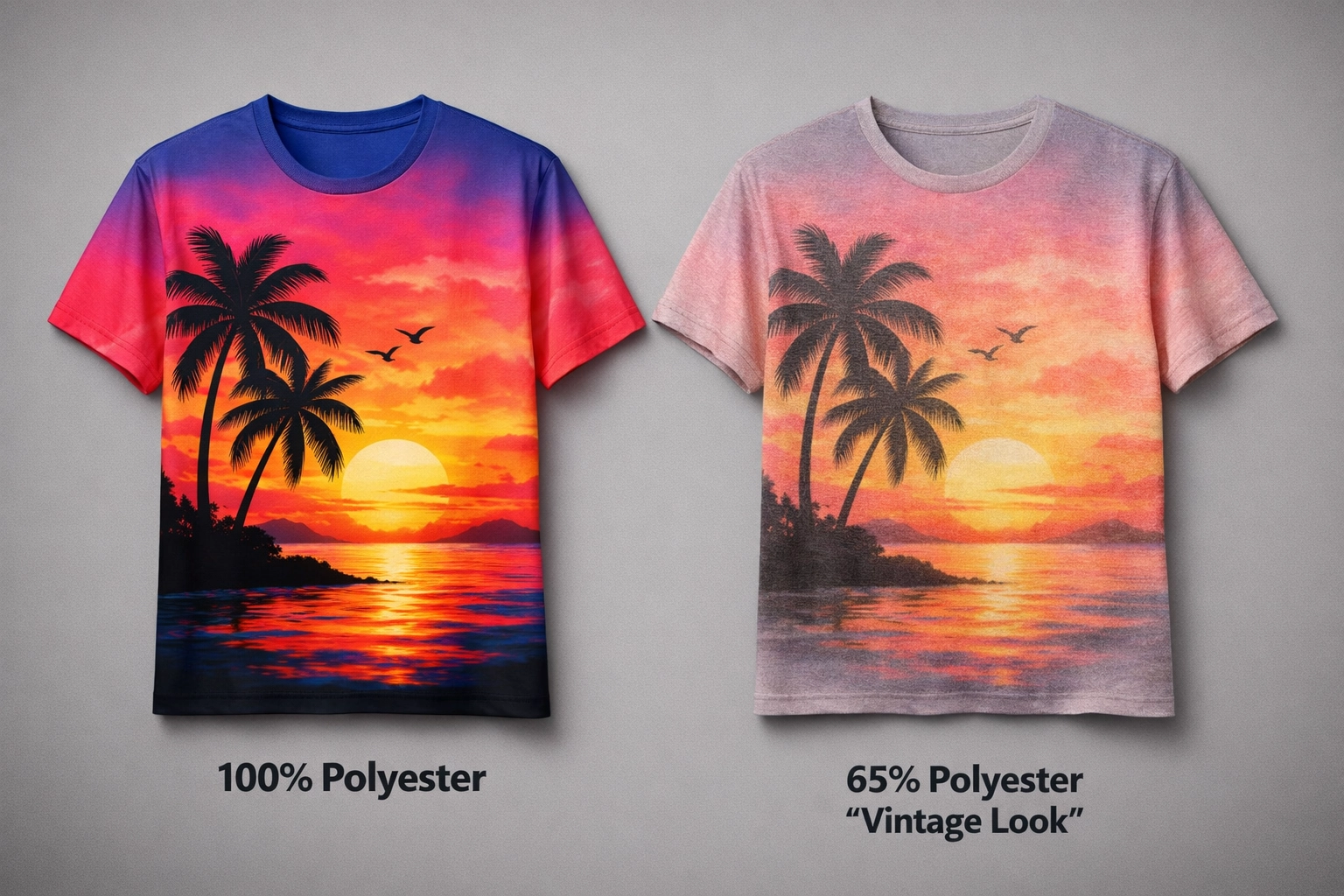
- The “Vintage” / Heathered Aesthetic: Because only the 65% polyester fibers capture the dye while the 35% cotton fibers remain un-dyed, the graphic appears softer and slightly desaturated compared to 100% polyester. This creates an authentic vintage, retro, or heathered aesthetic that is highly popular in lifestyle sportswear, retro athletic handwear, and casual fan apparel.
- The First-Wash Optical Shift: Immediately after heat pressing, surface dye that settled onto the cotton fibers may create an illusion of full color saturation. However, during the first domestic wash cycle, this loose unbonded surface dye completely washes away. Product developers must evaluate post-wash samples rather than pre-wash press proofs to judge true graphic color density accurately.
- Textile Hand Feel and Comfort: The core advantage of 65/35 blends over 100% polyester is skin feel. Incorporating 35% natural cotton creates a matte, ultra-soft hand that resists static cling and provides high moisture absorption, making it comfortable for casual glove liners, lifestyle hoodies, and corporate team uniforms.
Sublimation Fidelity Comparison: 100% Polyester vs 65/35 Blends
| Performance Parameter | 100% Technical Polyester | 65% Polyester / 35% Cotton Blend |
|---|---|---|
| Graphic Color Saturation | 100% Maximum CMYK color density; razor-sharp lines | 65–75% Color density; soft, muted, vintage tone |
| Post-Wash Graphic Retention | Permanent (Zero loss of detail across 50+ washes) | Stabilizes after first wash; vintage tone remains permanent |
| Fabric Surface Texture | Sleek, technical, smooth or micro-perforated | Soft, natural, breathable cotton-rich feel |
| Static & Pilling Resistance | High static potential; requires anti-static treatment | Low static; comfortable against sensitive skin |
| Recommended Fabric Color | White or light pastel tones for true color rendition | White or light heather grey for vintage aesthetic |
| Ideal Product Application | High-performance sports gloves, cycling, team jerseys | Lifestyle workout gloves, casual fanwear, retro uniforms |
| Factory Bulk MOQ | 500 Pairs / Units per custom design | 500 Pairs / Units per custom design |
Optimized Industrial Press Settings for 65/35 Blends
Sublimating on blended textiles requires specialized temperature and pressure calibration to prevent fabric damage. Because cotton scorches and yellows at high heat, factory press operators cannot utilize standard polyester heat profiles. At Mi-Gloves, we optimize sublimation on 65/35 blends using precise parameters:
- Calibrated Heat Window: Press temperature is held strictly at 190°C to 195°C (375°F to 385°F), preventing cotton fiber yellowing while ensuring complete disperse dye gasification.
- Dwell Time Optimization: Transfer dwell time is maintained between 40 and 50 seconds under medium pneumatic pressure (35 to 40 PSI).
- High-Tack Transfer Paper: Using high-tack sublimation paper eliminates micro-shifts and ghosting caused by moisture evaporation from natural cotton fibers during press closure.
- Pre-Press Moisture Extraction: Blended fabrics undergo a 5-second pre-press cycle to eliminate ambient humidity stored in cotton fibers prior to dye transfer.
Alternative Decoration Methods for Cotton-Rich Garments
If your brand requires razor-sharp, 100% opaque graphics on cotton-rich or dark-colored handwear and uniforms, Mi-Gloves provides proven alternative industrial decoration methods:
- Direct-to-Film (DTF) Industrial Transfers: Delivers photo-quality, stretchable graphics on any fabric blend with 100% opacity on dark backgrounds.
- High-Density Plastisol & Silicone Screen Printing: Creates bold, durable, tactile brand logos that grip cotton fibers securely.
- Sublimated Polyester Patch Appliques: Sublimating onto a 100% polyester twill badge and stitching it onto a cotton-rich glove or uniform, combining razor-sharp graphics with natural fabric comfort.
Turnkey OEM Contract Manufacturing from Mi-Gloves
As an experienced B2B glove manufacturer in Pakistan, Mi-Gloves delivers complete end-to-end production support for international apparel and sporting goods brands:
- Custom fabric knitting and dyeing to match exact Pantone textile specifications.
- Automated pattern laser-cutting and precision multi-needle stitching.
- Turnkey private-label packaging: branded header cards, barcode labeling, and export carton packing.
Consult our custom glove manufacturing experts, partner with an established wholesale handwear manufacturer, and review our companion guide on the best technical fabrics for sublimation printing.
Frequently Asked Questions (FAQs)
Will sublimated designs on 65% polyester continue to fade with every wash?
No. Fading occurs only during the first wash when loose, unbonded dye rinses off the cotton fibers. The dye trapped inside the 65% polyester filaments is permanent and will maintain its vintage tone for the life of the garment.
Can you sublimate on black or navy 65/35 poly-cotton gloves?
No. Sublimation inks are translucent and lack white pigment. Printing on dark fabrics results in invisible or severely darkened graphics. For dark garments, Direct-to-Film (DTF) or screen printing is required.
Is a 65/35 blend better for glove liners than 100% polyester?
For casual comfort and sweat absorption, many wearers prefer 65/35 poly-cotton liners because cotton feels softer against the skin. However, for extreme winter endurance sports, 100% polyester microfleece is superior due to faster moisture wicking.
Can you print photographic gradients on 65% polyester fabrics?
Yes. High-resolution Japanese printers reproduce photographic gradients accurately on 65% polyester, although the final printed image will exhibit a softer, heathered tonal depth.
What is your factory minimum order quantity for custom sublimated blends?
Our standard production MOQ starts at 500 pairs per style. We accommodate multi-size grading runs from XS to 3XL to match your brand’s demographic requirements.
What export documentation do you provide for international customs clearance?
We supply complete commercial invoices, packing lists, bill of lading, and Generalized System of Preferences (GSP) Certificates of Origin for tariff benefits in global ports.